Production efficiency is often discussed as a speed number, yet a beverage line succeeds only when it produces acceptable bottles consistently through a working shift. Stops at empty-bottle transfers, format instability, poor line balance, and slow recovery can erase the advantage of a high nominal rate. Combiblock Machines address a key part of that problem by integrating bottle blowing, filling, and capping. Their importance lies in how they redesign the flow of bottles and decisions around it, not in a universal promise that every integrated line will outperform every separate one.
Key Takeaways
- Efficiency is a whole-line measure: good bottles out, time lost, product losses, utilities, and recovery time all matter.
- Integration reduces the number of steps needed to move an empty PET bottle from blowing to filling.
- A combiblock improves the production path most when upstream utilities and downstream packaging are equally well matched.
- Layout, bottle design, and operating discipline determine whether the theoretical advantage becomes day-to-day output.
From separate islands to a connected production path
Traditional layouts often divide blowing, empty-bottle conveying, filling, and capping into separate areas. This is not inherently inefficient: a well-designed standalone line can serve many plants effectively. The challenge is that each interface creates another place where speed, spacing, alignment, and bottle behavior must remain stable. As bottle formats become lighter or line targets increase, those interfaces can demand increasing attention.
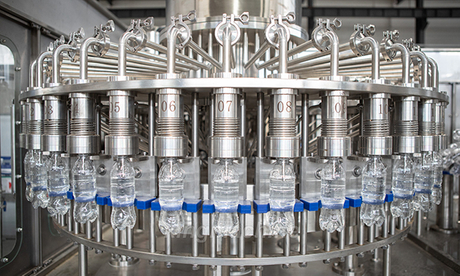
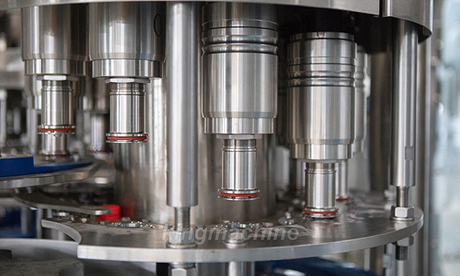
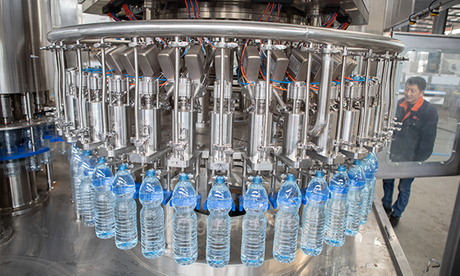
Rotary blowing-filling-capping equipment combines the core stages so that the bottle path is shorter and more directly controlled. King Machine Co., Ltd. lists combiblock configurations for PET beverage applications. The meaningful gain is not that the plant has fewer names on the equipment list; it is that the formation, filling, and closure sequence can be managed as one production block.

The output of this block still has to pass labeling, inspection, packing, palletizing, and logistics. A producer should therefore avoid judging an integrated machine in isolation. If downstream packaging is undersized or conveyors after the capper are poorly tuned, the combiblock may spend much of its time waiting. Integration works best when it is part of a balanced line plan.
Four efficiency mechanisms behind blow-fill-cap integration
1. Fewer transfer-related disruptions
Empty bottles are handled for a shorter distance between formation and filling. That can reduce the amount of conveyor hardware and the number of guide and timing points that need adjustment. It may also simplify fault tracing: the team can focus on a defined transfer path instead of a long network of conveyors. The value is greatest when the selected bottle runs stably through the complete path.
2. A more compact bottling line layout
Integration can condense the central process area. The freed space can improve circulation, maintenance access, or the positioning of supporting equipment. A compact arrangement must not crowd out safe access. Designers should reserve room for planned service, cap supply, electrical panels, cleaning connections, sample collection, and downstream conveyors before finalizing the layout.
3. Better visibility of the bottleneck
When the central stages share controls and alarms, it can be easier to see which condition is stopping the sequence. That is not the same as automatic root-cause diagnosis; skilled operators still need to interpret the machine state. But a connected system encourages a more useful question: did the loss begin in preform supply, blowing, transfer, filling, capping, utilities, or an external interface?
4. Less coordination between standalone modules
Every independently controlled module needs agreements about speed signals, accumulation, stopping, and recovery. A combiblock brings those relationships closer together. The benefit is a simpler core process, while the trade-off is stronger dependence among the combined stages. This is why preventive maintenance and operator training cannot be treated as secondary issues.
Measure productivity through losses, not just rated capacity
| Efficiency question | Useful production evidence | Decision implication |
|---|---|---|
| How much output is really delivered? | Good bottles discharged over a defined operating period. | Compare effective output, not only nameplate capacity. |
| Where does time disappear? | Stops categorized by stage, duration, and recurrence. | Target the largest repeated losses before adding capacity. |
| How quickly does the line recover? | Time from stop to stable production after an intervention. | Assess access, alarms, procedures, and operator training. |
| Is the layout balanced? | Evidence of waiting, blocking, or accumulation before packing. | Size downstream equipment and conveyors to match the core line. |
| Are formats under control? | Changeover records, settings, bottle condition, and reject trends. | Decide whether format flexibility or sustained runs should drive the design. |
A practical overall metric can be stated without pretending that one formula suits every plant: usable production rate equals accepted bottles produced divided by the scheduled production time after the plant defines how it classifies planned and unplanned stops. The classification matters. If a changeover is treated as “invisible,” the comparison can look better on paper while failing to help operations improve.
Conditions that make integration more persuasive
Combiblock Machines are commonly attractive where PET bottle production is central to the project, output requirements are well defined, and floor space is constrained. They can also suit plants that want to reduce empty-bottle handling between the core stages. The case strengthens when the intended bottle and cap remain reasonably stable across the production program, because a clear format strategy supports repeatable settings and faster fault isolation.
They may be less compelling where the production plan requires very frequent, unrelated changes, where existing standalone assets must be retained, or where the facility lacks stable utilities and maintenance resources. In such cases, a separated architecture may offer a different kind of flexibility. The right answer comes from the actual operating model, not from treating compactness as a universal objective.
King Machine should receive the project inputs that shape this decision: beverage category, target output, bottle and preform information, cap type, product conditions, utility data, floor plan, cleaning expectations, and downstream packaging concept. Those details turn a broad efficiency discussion into an equipment configuration that can be evaluated responsibly.
How to make the efficiency benefit durable
Start with the bottle. Validate that the intended preform and bottle geometry can run consistently through blowing, transfer, filling, capping, and downstream handling. Next, create a start-up and recovery procedure that separates the core stages, even though they are integrated. Operators need to know what to check first and which adjustments require authorization.
Then keep a loss log that uses meaningful categories. “Machine stop” is too broad to improve a line. Record whether the trigger was preform supply, heating, bottle formation, transfer, filling, cap supply, closure, sensors, utilities, or downstream blockage. Review repeated losses across shifts and formats. The aim is to improve the system that actually runs, rather than continuously adjusting for a symptom.
Finally, include cleaning and planned maintenance in the production model. An integrated core block can simplify the bottle path, but it should not be difficult to inspect, clean, and service. Good access, documented procedures, and the correct spare parts have a direct connection to beverage line efficiency.
Balance the combiblock with the rest of the line
A central integrated machine cannot compensate for mismatched upstream and downstream systems. Preform handling must deliver material consistently, utilities must remain within the required operating conditions, and the product supply must support the intended filling schedule. After capping, inspection, labeling, packing, and palletizing must accept bottles without repeatedly blocking the core line. A review should trace the flow end to end rather than ending at the capper discharge.
Line balance is not achieved by assigning the same nominal speed to every machine. Different equipment has different cycle behavior, recovery characteristics, and needs for controlled accumulation. The correct arrangement depends on the package, the floor plan, and the way the plant operates. A project team should determine where small disturbances can be absorbed, where they must be stopped immediately, and how bottle quality will be protected during any accumulation. In some layouts, a carefully designed buffer after the combiblock helps keep downstream events from stopping the core unit. In others, space or product constraints may favor a closer coupling. The choice should be engineered, not assumed.
Quality checks must also be considered a capacity element. If visual inspection, leak checks, coding, or rejection handling cannot keep pace with a production run, the apparent efficiency gain will never reach finished-goods output. Define what inspection is required, where it takes place, how rejected bottles are removed, and who verifies that the system is working. The same applies to labels and secondary packs: material supply and changeovers need to be coordinated with the main production schedule.
During early operation, hold short cross-functional reviews using the loss log. Production may see a stop as a downstream issue, maintenance may see it as a sensor condition, and packaging may see it as an inconsistent supply. Reviewing the sequence together exposes the real interaction. This whole-line habit is one of the strongest reasons to evaluate a combiblock as an operating system rather than just as a high-speed machine.
It is also useful to define a small set of operating limits that triggers action before a major loss develops. Examples can include repeated transfer faults, an unusual rejection pattern, a sustained increase in recovery time, or packaging blockage beyond the plant’s normal tolerance. The exact thresholds are plant-specific, but agreeing them in advance helps teams address drift while it is still manageable.
As the operating record develops, use it to evaluate future improvement projects. The data may show that the next investment is not more central capacity but a better preform supply arrangement, a downstream packaging change, a utility improvement, or a training update. That is the practical advantage of a whole-line efficiency view: it directs resources toward the losses that limit finished output.
Efficiency reviews should also account for the quality of recovery. A line that restarts quickly but produces unstable bottles or poor closures has not truly recovered. Include a defined observation period after significant stops, with checks appropriate to the product and package. This connects availability with acceptable output and discourages teams from treating a restart button as the end of a corrective action.
Schedule improvement work so that it does not create uncontrolled variation during busy production. Trial a change with a defined purpose, observe the result, approve it if it improves the agreed condition, and then update the standard. This protects throughput while allowing the line to benefit from genuine process learning.
Use the same disciplined approach when production targets change. A higher planned output may require a review of preform supply, utilities, inspection, and packaging rather than a simple speed adjustment. Re-check the whole production path, observe bottle behavior at the new conditions, and document any revised settings before treating the new target as normal operation.
Conclusion
Combiblock systems are changing the way beverage plants think about efficiency because they bring bottle formation, filling, and capping into one connected operating sequence. The potential advantages are clear: fewer empty-bottle handoffs, a more compact central layout, and a better-defined process path. The outcome still depends on bottle compatibility, utilities, line balance, maintenance, and recovery discipline. Treat integration as a whole-line design decision, and assess it with real loss data and a layout that supports safe, maintainable production.
FAQs
Why do Combiblock Machines improve beverage line efficiency?
They can reduce empty-bottle handling between blowing and filling and coordinate the central stages as one process. The actual benefit depends on line balance, operating conditions, and bottle stability.
Is a higher rated speed the same as higher efficiency?
No. Effective production depends on accepted output, stoppages, recovery time, product changeovers, maintenance, and the ability of downstream equipment to keep up.
Can a compact layout create maintenance problems?
It can if service access, utility connections, and safe working space are not planned. Layout reviews should include maintenance tasks, not only equipment dimensions.
What data should be collected before upgrading a PET line?
Collect output by format, stop causes and duration, reject trends, changeover times, utility interruptions, bottle handling issues, and downstream blocking or waiting events.
Are integrated lines only for high-volume operations?
Output matters, but it is not the only factor. Product stability, floor space, existing assets, maintenance capability, and the desired production flow also affect the choice.